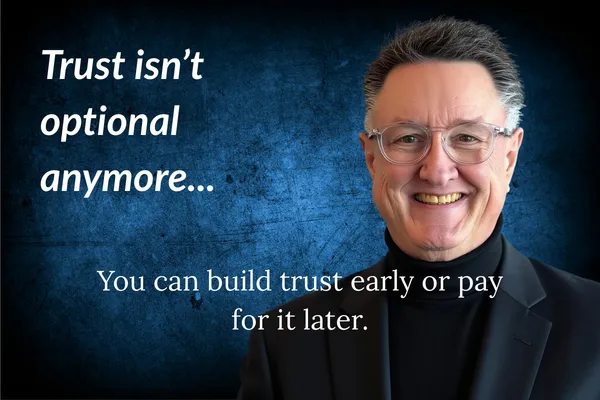
Build Trust First or Pay for It Later
Every business pays for trust.
The only question is when.
You can invest in trust early—through clarity, consistency, and confidence.
Or you can pay for it later—through longer sales cycles, deeper discounts, stalled momentum, and constant chasing.
Most companies don’t consciously choose either path.
They drift.
Sales feels heavier than it used to.
Buyers hesitate more.
Deals take longer to close.
Discounts become normal instead of rare.
Those aren’t market conditions.
They’re costs.
The cost of not building trust intentionally.
Trust is often treated like a side effect.
“If we do good work, trust will follow.”
That belief used to hold up.
It doesn’t anymore.
Today, buyers decide whether they trust you long before the first call.
They research quietly.
They compare silently.
They ask AI systems who feels credible.
By the time they talk to you, trust has already formed—or it hasn’t.
When trust isn’t established early, businesses compensate.
Sales talks more.
Marketing spends more.
Leadership pushes harder.
That effort feels productive.
It isn’t.
It just raises the cost of growth.
The companies that win don’t eliminate effort.
They eliminate unnecessary resistance.
They design for confidence.
They make it clear who they help.
They show proof that feels real and specific.
They explain the process so buyers don’t guess.
They follow up like real people are paying attention.
They say the same thing everywhere.
None of that is flashy.
All of it works.
When trust is strong, selling changes.
Calls feel lighter.
Decisions come faster.
Objections soften.
Discount pressure drops.
Referrals happen without asking.
Not because buyers are easier.
Because the environment feels safe.
The mistake many leaders make is waiting for a “big enough” problem before addressing trust.
A missed quarter.
A shrinking pipeline.
A sudden slowdown.
By then, trust has been leaking for months.
Trust leaks don’t announce themselves.
They show up as friction.
As fatigue.
As effort that doesn’t pay off the way it used to.
February has been about recognizing that pattern.
Seeing hesitation for what it really is.
Understanding why silence matters more than objections.
Realizing that fixing trust doesn’t require rebuilding everything.
Now comes the decision.
You can keep stacking tactics on top of uncertainty.
Or you can invest in trust—on purpose.
Before the next campaign.
Before the next tool.
Before the next push for volume.
Because the most expensive way to grow is ignoring trust until it becomes unavoidable.
Build it first.
Or pay for it later.